

Rental price list


VIGX ANT-H1 PRO
VIGX π PLUS
VIGX® exoskeletons
Try it without buying
Renting lets you try the exoskeleton in real conditions – at home, out walking, in the hills or during sport – with no immediate investment.
More power & less effort
An exoskeleton helps you walk, lift your legs, stay stable on uneven ground and cover longer distances. Ideal for hiking, travel or recovery.
Support for running, cycling or everyday movement
It reduces fatigue, supports the joints and improves the efficiency of your movement. Suitable for recreation, sport or maintaining fitness.
Excellent support during rehabilitation
An exoskeleton provides extra stability while recovering from injury or surgery. It helps re-establish a correct walking pattern.
Adjustable for different ages and body types
Suitable for younger people, older people and everyone in between – the exoskeleton adapts to your build and needs so that using it is comfortable, effective and safe.

VIGX® exoskeletons
VIGX exoskeletons combine advanced mechanics with artificial intelligence that adapts to the user's movement in real time.

Which exoskeleton should you choose?
Choosing the right exoskeleton is key to the device working properly and to getting the best results. It matters that the model is chosen for your needs, your physical capabilities and your goals.
Step 1: Choosing the right exoskeleton model
1.a) ✅ Choose the VIGX ANT-H1 PRO if at least one of the following applies:
- you are able to walk unaided, but with limitations or pain
- you experience pain when walking
- you are in rehabilitation after an injury
- you are recovering after a stroke
- you have difficulty walking with both legs or with just one leg (e.g. left or right)
- you are older and want to stay active and independent
👉 The ANT-H1 PRO is designed as an aid to walking and movement support, not as a sports accessory.
1.b) 💪 Choose the VIGX π Plus if:
- you are a recreational athlete and want to maintain or improve your fitness
- you have no direct difficulty walking
- you walk a lot and want to cover more ground in less time
- you want to lose weight
- you want to reduce fatigue on longer walks
- you take part recreationally in sports such as cycling, running, hill walking, cross-country skiing and similar activities
Step 2: Choosing the right size
The second most important step in choosing an exoskeleton is picking the right size.
If the exoskeleton is too large or too small for your build, it will not work optimally and you will not get the full benefit from it.
2.a) 📏 Sizing – VIGX ANT-H1 PRO
The ANT-H1 PRO is suitable for users who are able to walk unaided.
Thigh section size (by user height):
- S: 150–165 cm
- M: 160–175 cm
- L: 170–185 cm
Waist size:
- M: hip width: 26–34 cm, waist circumference: 60–95 cm
- L: hip width: 30–38 cm, waist circumference: 76–113 cm
- XL: hip width: 34–42 cm, waist circumference: 95–133 cm
2.b) 📐 Sizing – VIGX π Plus
Frame size (by user height):
- S: 150–165 cm
- M: 165–185 cm
- L: 180–200 cm
Waist size (circumference):
- S: 72–82 cm
- M: 82–100 cm
- L: 100–125 cm
Leg strap size (circumference):
- S: 30–45 cm
- M: 40–62 cm
If you are not sure which size or model is right for you, we recommend calling us before you buy on 030 771 787 or emailing [email protected].
We will gladly help you find the most suitable size for your build.
Try it for free!📍
You are warmly invited to our showroom, where you can try the VIGX ANT-H1 PRO and VIGX π Plus exoskeletons completely free of charge.
Frequently asked questions
Read the frequently asked questions about VIGX exoskeletons. If you have any further questions, please call us on 030 771 787.
What an exoskeleton is NOT
Which conditions and diagnoses is an exoskeleton generally not suitable for?
Is the ANT-H1 PRO a medical device?
Can I use the exoskeleton without any prior experience?
How do I know whether I am a suitable candidate for an exoskeleton?
Is the exoskeleton suitable for older people?
How long does it take to get used to wearing the exoskeleton?
Can I also use the exoskeleton for sport or recreation?
Is an exoskeleton safe to use?
Who is the ANT-H1 PRO for?
Can the ANT-H1 PRO be used by someone with complete paralysis of the legs?
I have walking difficulties with only one leg. Which exoskeleton do you recommend?
Who is the VIGX π Plus for?
Is the π Plus suitable for rehabilitation?
Can the π Plus help me lose weight?
Can I use the π Plus every day?
Exoskeleton VIGX π Plus


Exoskeleton VIGX ANT H-1 PRO


VIGX® Exoskeletons
-

 Sold outNew
VIGX π Plus Exoskeleton
Regular price From 1.799,90 EURSale price From 1.799,90 EUR Regular priceUnit price per12,000 - 24,000 steps -

 New
NewExoskeleton VIGX ANT-H1 PRO
Regular price From 2.699,90 EURSale price From 2.699,90 EUR Regular priceUnit price per12,000 steps -

 Sold outNew
Exoskeleton VIGX ANT-WA1
Regular price 10.299,90 EURSale price 10.299,90 EUR Regular priceUnit price per4 - 5 hours -

 Sold outNew
Exoskeleton VIGX A10
Regular price 2.799,90 EURSale price 2.799,90 EUR Regular priceUnit price per4 - 5 hours -

 Sold outNew
Exoskeleton VIGX Q20
Regular price 2.399,90 EURSale price 2.399,90 EUR Regular priceUnit price per4 - 5 hours -

 Sold outNew
VIGX π Exoskeleton
Regular price From 1.599,90 EURSale price From 1.599,90 EUR Regular priceUnit price per12,000 steps


Blog posts
-

Operation Calypso: The €700M E-Scooter Scam That Shook Europe
A major investigation by the European Public Prosecutor’s Office (EPPO)...2 min read -

A New Era of Micromobility: The Elite VSETT and DUALTRON 2025 Collection Has Arrived
A New Era of Micromobility: The Elite VSETT and DUALTRON...4 min read -

EVOLT x EKO DRIVE: Powering the Future of Electro-Micromobility
Starting from August 1st, 2025, EVOLT d.o.o. is officially joining...2 min read -
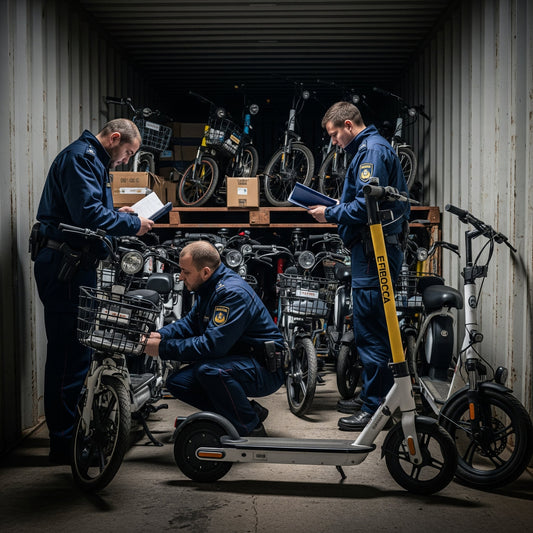
How Chinese Sellers Smuggle E‑Scooters and E‑Bikes into the EU
European authorities are cracking down on a wave of imported...13 min read -

The Pitfalls of Buying E-Scooters and E-Bikes from Online Marketplaces
This article explains these risks in detail and strongly recommends...7 min read -

Electric Vehicles and the Environment: Are They Really Eco-Friendly?
Electric vehicles (EVs) promise cleaner transport, but how green are...2 min read -

The Future of Urban Mobility: Why Europe Is Switching to E-Mobility
Europe’s big cities are betting on electric mobility to hit...3 min read -

Navigating EU Roads with Your E-Scooter or Bike: A Guide to Local Laws
Welcome to eVolt.eu! As you explore our range of electric...7 min read


