


SMK Stellar Sport Flight integral helmet GL257C – black/blue/orange
Delivery time within EU
3-7 working days

Unfortunately this product is out of stock.
But we can let you know as soon as it is available again.
SMK Stellar Sport Flight Full-Face Helmet GL257C – Black/Blue/Orange
The SMK Stellar Sport Flight GL257C full-face helmet is a full-face motorcycle helmet from the SMK brand, Flight graphics, in black / blue / orange. It is designed for road riding, everyday use, and longer trips and is approved according to the ECE 22.06 standard.

Key features
- ECE 22.06 homologation – compliance with the latest European safety standard.
- Thermoplastic shell – resistant, durable, and suitably lightweight.
- Micro-regulation buckle for reliable and precise fastening.
- Removable and washable inner lining for greater comfort and hygiene.
- Integral design protects the entire face and head.
- Unisex design – suitable for men and women.
Technical specifications
| Brand | SMK |
| Model | Stellar Sport (Flight graphics) |
| Product code | GL257C |
| Helmet type | Integral (full-face) |
| Color | black / blue / orange |
| Shell material | Thermoplastic |
| Buckle | Micro-regulation |
| Helmet weight | approx. 1570 g |
| Removable inner lining | Yes |
| Pinlock | No |
| Sun visor | No |
| Homologation | ECE 22.06 |
| Gender | Unisex |
Size chart
| Size | Head circumference |
|---|---|
| XS | 54 cm |
| S | 55 cm |
| M | 57 cm |
| L | 59 cm |
| XL | 61 cm |
We recommend measuring your head circumference (at the widest part) to choose the most suitable size.
What does ECE 22.06 homologation mean?
ECE 22.06 is the current version of the international safety standard UN Regulation No. 22 for protective motorcycle helmets. Homologation confirms that the helmet type has been tested according to prescribed procedures and meets the required conditions regarding protection, construction, fastening system, field of vision, and other safety features.
The ECE 22.06 standard uses more demanding and comprehensive tests than the previous ECE 22.05 version. Helmets are checked at different speeds and in multiple shell areas, which better assesses their performance in various types of traffic and off-road accidents.
What is checked under the ECE 22.06 standard?
- Impact energy absorption – checks how much energy the helmet transfers to the head upon impact.
- Impacts at different speeds – the helmet is tested at multiple load levels, not just at one speed.
- Multiple impact zones – different parts of the shell are tested, including additional randomly selected points.
- Oblique or rotational impacts – the stress that can cause rotational head movement is also evaluated.
- Shell and inner protective layer strength – checks the construction's ability to withstand prescribed loads.
- Helmet stability on the head – the helmet must not easily come off or slide from the head during an accident.
- Buckle and chin strap strength – the fastening system must remain closed and correctly positioned even under high loads.
- User's field of vision – the helmet's construction must not dangerously restrict vision while riding.
- Safety of additional equipment – accessories and attachment points must not reduce the helmet's protective properties.


Spare parts by brand
-

Spare Parts for KuKirin Electric Scooters
182 productos -

Piezas de repuesto para patinetes eléctricos Xiaomi
131 productos -

Repuestos para patinetes eléctricos Segway
59 productos -

Spare Parts for Engwe Electric Bikes
44 productos -

Spare Parts for ECO Speed Electric Scooters
61 productos -

Piezas de repuesto para monociclos eléctricos KingSong
518 productos


Blog posts
Stay up to date with the latest in electric micromobility.
-

Operación Calipso: La estafa de 700 millones de euros en patinetes eléctricos que sacudió Europa
Una importante investigación de la Fiscalía Europea (EPPO) ha revelado...3 min de lectura -

Una nueva era de la micromovilidad: La colección 2025 de élite de VSETT y DUALTRON ha llegado.
Una nueva era de la micromovilidad: La colección de élite...4 min de lectura -
EVOLT x EKO DRIVE: Impulsando el futuro de la electromicromovilidad
A partir del 1 de agosto de 2025, EVOLT d.o.o....2 min de lectura -
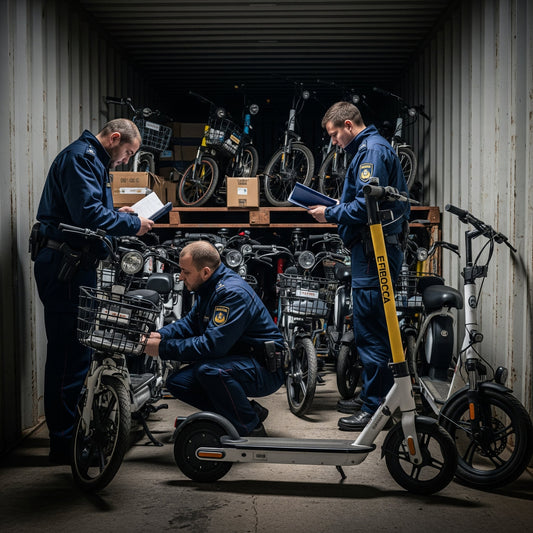
Cómo los vendedores chinos introducen de contrabando patinetes eléctricos y bicicletas eléctricas en la Unión Europea
Las autoridades europeas están tomando medidas enérgicas contra una oleada...17 min de lectura -

Los peligros de comprar patinetes eléctricos y bicicletas eléctricas en mercados en línea.
Este artículo explica estos riesgos en detalle y recomienda encarecidamente...8 min de lectura -

Vehículos eléctricos y el medio ambiente: ¿Son realmente ecológicos?
Los vehículos eléctricos prometen un transporte más limpio, pero ¿qué...3 min de lectura -

El futuro de la movilidad urbana: Por qué Europa está cambiando a la movilidad eléctrica
Las grandes ciudades de Europa están apostando por la movilidad...4 min de lectura -
Circular por las carreteras de la UE con su patinete eléctrico o bicicleta: Una guía sobre las leyes locales
¡Bienvenido a eVolt.eu! Mientras explora nuestra gama de patinetes eléctricos...8 min de lectura


