

Liste de prix de location


VIGX ANT-H1 PRO
VIGX π PLUS
Exosquelettes VIGX®
Essayez-le sans l'acheter
La location vous permet d'essayer l'exosquelette dans des conditions réelles – à la maison, en marchant, en montagne ou pendant le sport – sans investissement immédiat.
Plus de puissance et moins d'effort
Un exosquelette vous aide à marcher, à lever les jambes, à rester stable sur un terrain accidenté et à parcourir de plus longues distances. Idéal pour la randonnée, les voyages ou la récupération.
Soutien pour la course, le cyclisme ou le mouvement quotidien
Il réduit la fatigue, soutient les articulations et améliore l'efficacité de vos mouvements. Convient pour les loisirs, le sport ou le maintien de la forme physique.
Excellent support pendant la rééducation
Un exosquelette offre une stabilité supplémentaire pendant la récupération après une blessure ou une intervention chirurgicale. Il aide à rétablir un schéma de marche correct.
Ajustable pour différentes ages et morphologies
Convient aux plus jeunes, aux plus âgés et à toutes les personnes entre les deux – l'exosquelette s'adapte à votre morphologie et à vos besoins pour que son utilisation soit confortable, efficace et sûre.

VIGX® exosquelettes
Les exosquelettes VIGX combinent une mécanique avancée avec une intelligence artificielle qui s'adapte aux mouvements de l'utilisateur en temps réel.

Quel exosquelette choisir ?
Le choix de l'exosquelette adapté est essentiel pour un fonctionnement correct de l'appareil et pour obtenir les meilleurs résultats. Il est important que le modèle soit choisi en fonction de vos besoins, de vos capacités physiques et de vos objectifs.
Étape 1 : Choisir le bon modèle d'exosquelette
1.a) ✅ Choisissez le VIGX ANT-H1 PRO si au moins une des conditions suivantes s'applique :
- vous êtes capable de marcher sans aide, mais avec des limitations ou des douleurs
- vous ressentez des douleurs en marchant
- vous êtes en rééducation après une blessure
- vous vous remettez après un AVC
- vous avez des difficultés à marcher avec les deux jambes ou avec une seule jambe (par exemple, gauche ou droite)
- vous êtes plus âgé et souhaitez rester actif et indépendant
👉 L'exosquelette ANT-H1 PRO est conçu comme une aide à la marche et un support de mouvement, et non comme un accessoire sportif.
1.b) 💪 Choisissez le VIGX π Plus si :
- vous êtes un athlète de loisir et souhaitez maintenir ou améliorer votre condition physique
- vous n'avez pas de difficulté directe à marcher
- vous marchez beaucoup et souhaitez parcourir plus de terrain en moins de temps
- vous voulez perdre du poids
- vous voulez réduire la fatigue lors de longues marches
- vous participez à des sports de loisir tels que le cyclisme, la course à pied, la randonnée en montagne, le ski de fond et des activités similaires
Étape 2 : Choisir la bonne taille
La deuxième étape la plus importante dans le choix d'un exosquelette est de choisir la bonne taille.
Si l'exosquelette est trop grand ou trop petit pour votre morphologie, il ne fonctionnera pas de manière optimale et vous n'en tirerez pas tous les bénéfices.
2.a) 📏 Guide des tailles – VIGX ANT-H1 PRO
L'ANT-H1 PRO convient aux utilisateurs capables de marcher sans aide.
Taille de la section de la cuisse (selon la taille de l'utilisateur) :
- S : 150–165 cm
- M : 160–175 cm
- L : 170–185 cm
Tour de taille :
- M : largeur des hanches : 26–34 cm, tour de taille : 60–95 cm
- L : largeur des hanches : 30–38 cm, tour de taille : 76–113 cm
- XL : largeur des hanches : 34–42 cm, tour de taille : 95–133 cm
2.b) 📐 Guide des tailles – VIGX π Plus
Taille du cadre (selon la taille de l'utilisateur) :
- S : 150–165 cm
- M : 165–185 cm
- L : 180–200 cm
Tour de taille (circonférence) :
- S : 72–82 cm
- M : 82–100 cm
- L : 100–125 cm
Taille de la sangle de jambe (circonférence) :
- S : 30–45 cm
- M : 40–62 cm
Si vous n'êtes pas sûr de la taille ou du modèle qui vous convient, nous vous recommandons de nous appeler avant d'acheter au 030 771 787 ou d'envoyer un e-mail à [email protected].
Nous vous aiderons avec plaisir à trouver la taille la plus adaptée à votre morphologie.
Essayez-le gratuitement !📍
Vous êtes cordialement invités dans notre showroom, où vous pourrez essayer les exosquelettes VIGX ANT-H1 PRO et VIGX π Plus entièrement gratuitement.
Foire aux questions
Lisez la foire aux questions sur les exosquelettes VIGX. Si vous avez d'autres questions, veuillez nous appeler au 030 771 787.
Ce qu'un exosquelette n'est PAS
Dans quelles conditions et diagnostics un exosquelette n'est-il généralement pas adapté ?
L'ANT-H1 PRO est-il un appareil médical ?
Puis-je utiliser l'exosquelette sans aucune expérience préalable ?
Comment savoir si je suis un candidat approprié pour un exosquelette ?
L'exosquelette convient-il aux personnes âgées ?
Combien de temps faut-il pour s'habituer à porter l'exosquelette ?
Puis-je aussi utiliser l'exosquelette pour le sport ou les loisirs ?
Est-il sûr d'utiliser un exosquelette ?
Qui est l'ANT-H1 PRO pour ?
La ANT-H1 PRO peut-elle être utilisée par une personne complètement paralysée des jambes ?
J'ai des difficultés à marcher avec une seule jambe. Quel exosquelette me recommandez-vous ?
À qui s'adresse le VIGX π Plus ?
Le π Plus est-il adapté à la rééducation ?
Est-ce que le π Plus peut m'aider à perdre du poids ?
Puis-je utiliser le π Plus tous les jours ?
Exosquelette VIGX π Plus


Exosquelette VIGX ANT H-1 PRO


VIGX® Exosquelettes
-

 ÉpuiséNouveau
Exosquelette VIGX π Plus
Prix habituel Du 1.799,90 EURPrix promotionnel Du 1.799,90 EUR Prix habituelPrix unitaire par12 000 - 24 000 pas -

 Nouveau
Exosquelette VIGX ANT-H1 PRO
Prix habituel Du 2.699,90 EURPrix promotionnel Du 2.699,90 EUR Prix habituelPrix unitaire par12 000 pas -

 ÉpuiséNouveau
Exosquelette VIGX ANT-WA1
Prix habituel 10.299,90 EURPrix promotionnel 10.299,90 EUR Prix habituelPrix unitaire par4 - 5 heures -

 ÉpuiséNouveau
Exosquelette VIGX A10
Prix habituel 2.799,90 EURPrix promotionnel 2.799,90 EUR Prix habituelPrix unitaire par4 - 5 heures -

 ÉpuiséNouveau
Exosquelette VIGX Q20
Prix habituel 2.399,90 EURPrix promotionnel 2.399,90 EUR Prix habituelPrix unitaire par4 - 5 heures -

 ÉpuiséNouveau
Exosquelette VIGX π
Prix habituel Du 1.599,90 EURPrix promotionnel Du 1.599,90 EUR Prix habituelPrix unitaire par12 000 pas


Billets de blog
-

Opération Calypso : L'escroquerie aux trottinettes électriques de 700 millions d'euros qui a ébranlé l'Europe
Une enquête d'envergure menée par le Parquet européen a révélé...3 min de lecture -

Une nouvelle ère de la micromobilité : la collection d'élite VSETT et DUALTRON 2025 est arrivée
Une nouvelle ère de la micromobilité : La collection élite...4 min de lecture -

EVOLT x EKO DRIVE : Propulser l'avenir de l'électro-micromobilité
À partir du 1er août 2025, EVOLT d.o.o. unit officiellement...2 min de lecture -
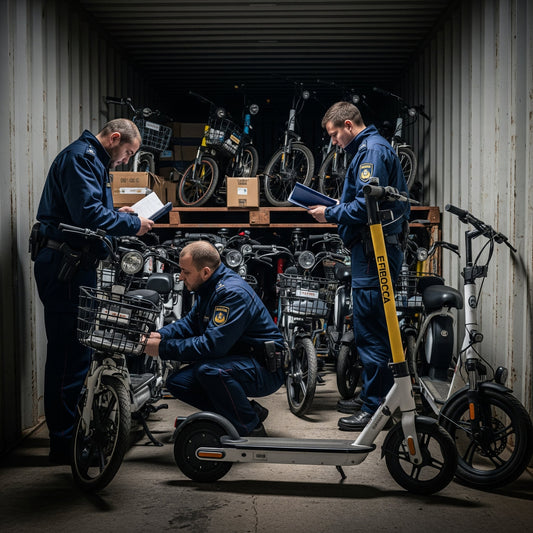
Comment les vendeurs chinois introduisent illégalement des trottinettes électriques et des vélos électriques dans l'Union européenne
Les autorités européennes sévissent contre une vague de vélos électriques...16 min de lecture -

Les pièges de l'achat de trottinettes électriques et de bicyclettes électriques sur les places de marché en ligne
Cet article explique ces risques en détail et recommande vivement...9 min de lecture -

Les véhicules électriques et l'environnement : sont-ils réellement respectueux de l'environnement ?
Les véhicules électriques promettent un transport plus propre, mais quel...3 min de lecture -

L'avenir de la mobilité urbaine : Pourquoi l'Europe passe à la mobilité électrique
Les grandes villes d'Europe misent sur la mobilité électrique pour...4 min de lecture -

Naviguer sur les routes de l'Union européenne avec votre trottinette électrique ou votre bicyclette : Un guide des lois locales
Bienvenue sur eVolt.eu ! En explorant notre gamme de trottinettes...8 min de lecture


