


SMK Stellar Sport Flight integral helmet MA264 – black/grey/yellow
Delivery time within EU
3-7 working days

SMK Stellar Sport Flight Full-Face Helmet MA264 – Black/Grey/Yellow
The SMK Stellar Sport Flight Full-Face Helmet MA264 is a full-face motorcycle helmet from the brand SMK, Flight graphic, in black / grey / yellow. It is designed for road riding, everyday use, and longer journeys and is homologated according to the ECE 22.06 standard.

Key Features
- ECE 22.06 homologation – compliance with the latest European safety standard.
- Thermoplastic shell – resistant, durable, and suitably lightweight.
- Micro-adjustable buckle for reliable and precise fastening.
- Removable and washable inner lining for greater comfort and hygiene.
- Full-face design protects the entire face and head.
- Unisex design – suitable for men and women.
Technical Specifications
| Brand | SMK |
| Model | Stellar Sport (Flight graphic) |
| Product code | MA264 |
| Helmet type | Full-face |
| Color | black / grey / yellow |
| Shell material | Thermoplastic |
| Buckle | Micro-adjustable |
| Helmet weight | approx. 1570 g |
| Removable inner lining | Yes |
| Pinlock | No |
| Sun visor | No |
| Homologation | ECE 22.06 |
| Gender | Unisex |
Size Chart
| Size | Head Circumference |
|---|---|
| XS | 54 cm |
| S | 55 cm |
| M | 57 cm |
| L | 59 cm |
| XL | 61 cm |
We recommend measuring your head circumference (at the widest part) to choose the most suitable size.
What does ECE 22.06 homologation mean?
ECE 22.06 is the current version of the international safety standard UN Regulation No. 22 for protective motorcycle helmets. Homologation confirms that the helmet type has been tested according to prescribed procedures and meets the required conditions for protection, construction, retention system, field of vision, and other safety features.
The ECE 22.06 standard uses more demanding and extensive tests than the previous ECE 22.05 version. Helmets are checked at different speeds and in multiple areas of the shell, which better evaluates their performance in various types of traffic and off-road accidents.
What is checked under the ECE 22.06 standard?
- Impact energy absorption – checks how much energy the helmet transfers to the head upon impact.
- Impacts at different speeds – the helmet is tested at multiple load levels, not just one speed.
- Multiple impact zones – various parts of the shell are tested, including additional randomly selected points.
- Oblique or rotational impacts – the stress that can cause rotational head movement is also evaluated.
- Shell and inner protective layer strength – checks the construction's ability to withstand prescribed loads.
- Helmet stability on the head – the helmet must not easily come off or slide from the head during an accident.
- Buckle and chin strap strength – the retention system must remain closed and correctly positioned even under high loads.
- User's field of vision – the helmet's construction must not dangerously restrict the view while riding.
- Accessory safety – accessories and attachment points must not reduce the helmet's protective properties.


Spare parts by brand
-

Spare Parts for KuKirin Electric Scooters
182 prodotti -

Pezzi di ricambio per monopattini elettrici Xiaomi
131 prodotti -

Spare Parts for Engwe Electric Bikes
44 prodotti -

Spare Parts for ECO Speed Electric Scooters
61 prodotti -

Parti di ricambio per monocicli elettrici KingSong
518 prodotti


Blog posts
Stay up to date with the latest in electric micromobility.
-

Operazione Calypso: la truffa dei monopattini elettrici da 700 milioni di euro che ha scosso l'Europa
Un'importante indagine della Procura europea (EPPO) ha rivelato come reti...3 minuti di lettura -

Una nuova era della micromobilità: la collezione Elite VSETT e DUALTRON 2025 è arrivata
Una nuova era della micromobilità: la collezione d'élite VSETT e...4 minuti di lettura -
EVOLT x EKO DRIVE: Alimentare il futuro della micromobilità elettrica
A partire dal 1° agosto 2025, EVOLT d.o.o. unisce ufficialmente...2 minuti di lettura -
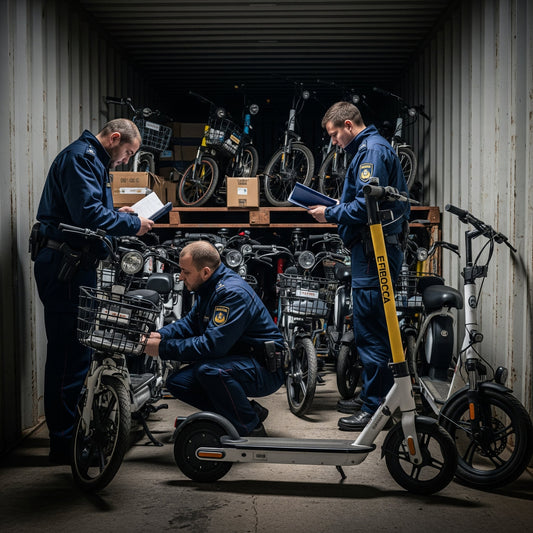
Come i venditori cinesi contrabbandano monopattini elettrici e biciclette elettriche nell'Unione Europea
Le autorità europee stanno contrastando un'ondata di biciclette elettriche e...15 minuti di lettura -

Le insidie dell'acquisto di monopattini elettrici e biciclette elettriche sui marketplace online
Questo articolo spiega questi rischi nel dettaglio e raccomanda vivamente...8 minuti di lettura -

Veicoli elettrici e l'ambiente: sono davvero ecosostenibili?
I veicoli elettrici promettono un trasporto più pulito, ma quanto...3 minuti di lettura -

Il futuro della mobilità urbana: perché l'Europa sta transitando verso la mobilità elettrica
Le grandi città europee stanno puntando sulla mobilità elettrica per...3 minuti di lettura -
Navigare sulle strade dell'UE con il vostro monopattino elettrico o la vostra bicicletta: Una guida alle leggi locali
Benvenuti su eVolt.eu! Mentre esplorate la nostra gamma di monopattini...8 minuti di lettura


