

SMK Typhoon helmet with visor 115/24/MA200 – matt black
Delivery time within EU
3-7 working days

Unfortunately this product is out of stock.
But we can let you know as soon as it is available again.
SMK Typhoon full-face helmet MA200 – matte black
The SMK Typhoon 115/24/MA200 is a full-face motorcycle helmet in matte black, designed for everyday road riding, sport touring, and longer journeys. Its compact aerodynamic shape provides good protection for the entire head and face, while the ventilation system contributes to greater comfort during riding.
The helmet is made of durable thermoplastic, equipped with an internal sun visor, a removable inner lining, and a practical Microlock micro-adjustment buckle. ECE 22.06 homologation confirms compliance with the current European safety standard for motorcycle helmets.
Key features
- ECE 22.06 homologation – compliance with the current European safety standard.
- Full-face design for protection of the entire head, face, and chin.
- Thermoplastic shell with an aerodynamic and compact shape.
- Integrated internal sun visor for protection against glare and strong sunlight.
- Wide clear outer visor for good visibility while riding.
- Pinlock ready – compatible with Pinlock 70 or Pinlock 30 inserts, depending on the visor version.
- Microlock micro-adjustment buckle for quick and precise fastening.
- Removable inner lining for easier cleaning and maintenance.
- Ventilation openings in the chin area and the upper part of the helmet.
- Suitable for sport touring, daily commutes, and longer journeys.
- Unisex design – suitable for men and women.
Technical specifications
| Brand | SMK |
| Model | Typhoon Solid |
| Color code | MA200 |
| Color | Matte black |
| Helmet type | Full-face |
| Shell material | Thermoplastic |
| Shell shape | Compact and aerodynamic |
| Buckle type | Microlock micro-adjustment buckle |
| Outer visor | Clear, wide-angle and replaceable |
| Internal sun visor | Yes |
| Pinlock ready | Yes, compatible with Pinlock 70 or Pinlock 30 |
| Pinlock insert included | No, unless stated otherwise for a specific version |
| Ventilation | Front and top ventilation openings |
| Removable inner lining | Yes |
| Weight size XS–M | Approximately 1575 g ± 50 g |
| Weight size L–XL | Approximately 1675 g ± 50 g |
| Homologation | ECE 22.06 |
| Gender | Unisex |
| Available sizes | XS, S, M, L and XL |
Size chart
| Size | Head circumference | Approximate weight |
|---|---|---|
| XS | 54 cm | 1575 g ± 50 g |
| S | 55 cm | 1575 g ± 50 g |
| M | 57 cm | 1575 g ± 50 g |
| L | 59 cm | 1675 g ± 50 g |
| XL | 61 cm | 1675 g ± 50 g |
To choose the correct size, measure your head circumference with a tape measure approximately one centimeter above your eyebrows and above your ears. The helmet should fit evenly around your entire head and should not move or slide independently when you move your head.
What does ECE 22.06 homologation mean?
ECE 22.06 is the current version of the international safety standard UN Regulation No. 22 for protective motorcycle helmets. Homologation confirms that the helmet type has been tested according to prescribed procedures and meets the required conditions regarding protection, construction, fastening system, field of vision, and other safety features.
The ECE 22.06 standard uses more demanding and extensive tests than the previous ECE 22.05 version. Helmets are checked at different speeds and in multiple areas of the shell, which better assesses their performance in various types of traffic and off-road accidents.
What is checked under the ECE 22.06 standard?
- Impact energy absorption – checks how much energy the helmet transfers to the head upon impact.
- Impacts at different speeds – the helmet is tested at multiple load levels and not just at a single speed.
- Multiple impact zones – various parts of the shell are tested, including additional randomly selected points.
- Oblique or rotational impacts – also assesses the stress that can cause rotational movement of the head.
- Shell strength and inner protective layer – checks the construction's ability to withstand prescribed loads.
- Helmet stability on the head – the helmet should not easily come off or slide off the head during an accident.
- Buckle and chin strap strength – the fastening system must remain closed and properly positioned even under greater loads.
- User's field of vision – the helmet's construction must not dangerously restrict the view while riding.
- Safety of accessories – accessories and attachment points must not reduce the helmet's protective properties.


Spare parts by brand
-

Spare Parts for KuKirin Electric Scooters
182 Produkte -

Ersatzteile für Xiaomi Elektroroller
131 Produkte -

Ersatzteile für Segway Elektroroller
59 Produkte -

Spare Parts for Engwe Electric Bikes
44 Produkte -

Spare Parts for ECO Speed Electric Scooters
61 Produkte -

Ersatzteile für Veleco Elektromobile
1180 Produkte -

Ersatzteile für KingSong Elektrische Einräder
518 Produkte


Blog posts
Stay up to date with the latest in electric micromobility.
-

Operation Calypso: Der 700-Millionen-Euro-Elektroroller-Betrug, der Europa erschütterte
Eine umfassende Untersuchung der Europäischen Staatsanwaltschaft (EUStA) hat aufgedeckt, wie...3 Min. Lesezeit -

Eine neue Ära der Mikromobilität: Die Elite-Kollektion 2025 von VSETT und DUALTRON ist eingetroffen.
Eine neue Ära der Mikromobilität: Die Elite-Kollektion 2025 von VSETT...4 Min. Lesezeit -
EVOLT x EKO DRIVE: Die Zukunft der Elektro-Mikromobilität gestalten.
Ab dem 1. August 2025 schließt sich EVOLT d.o.o. offiziell...2 Min. Lesezeit -
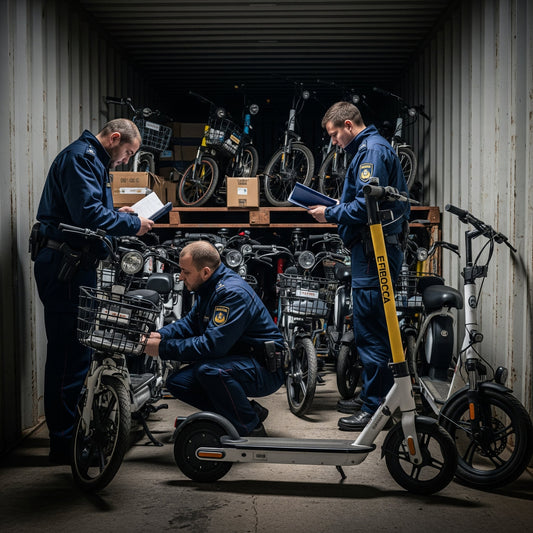
Wie chinesische Verkäufer Elektroroller und Elektrofahrräder in die Europäische Union schmuggeln
Europäische Behörden gehen hart gegen eine Welle importierter Elektrofahrräder und...13 Min. Lesezeit -

Die Tücken beim Kauf von Elektrorollern und Elektrofahrrädern auf Online-Marktplätzen
Dieser Artikel erläutert diese Risiken im Detail und empfiehlt ausdrücklich...7 Min. Lesezeit -

Elektrofahrzeuge und die Umwelt: Sind sie wirklich umweltfreundlich?
Elektrofahrzeuge versprechen einen saubereren Transport, aber wie umweltfreundlich sind sie...2 Min. Lesezeit -

Die Zukunft der urbanen Mobilität: Warum Europa auf Elektromobilität umsteigt
Europas Großstädte setzen auf Elektromobilität, um Klimaziele zu erreichen, Straßen...3 Min. Lesezeit -
Mit E-Scooter oder Fahrrad auf EU-Straßen unterwegs: Ein Leitfaden zu lokalen Gesetzen
Willkommen bei eVolt.eu! Während Sie unser Angebot an Elektrorollern und...7 Min. Lesezeit


